
8 min read
Building the Foundation for a National Health
Geo-Registry in DRC
Building the Foundation for a National Health Geo-Registry in DRC

Published on
Published on: April 2026
April 2026
Introduction (French)
In 2025, the Democratic Republic of Congo took a meaningful step forward in the digital transformation of its health system. With support from the Gates Foundation through the Umbrella Fund, the country began laying the groundwork for something it had long needed: a centralised health geo-registry that could bring order, coherence, and visibility to a fragmented landscape of health data.
This national effort was led by the National Agency for Clinical and Digital Health Engineering (ANICNS), the government institution mandated to coordinate and advance the country's digital health agenda. Technical coordination was provided by Bluesquare, and quality oversight by Dev-Afrique. Together, these three partners developed a system architecture framework for ANICNS's centralised geo-registry, designed from the outset to serve as a long-term national asset for the health sector.
Why a National Health Geo-Registry?
The DRC did not lack health data. What it lacked was coherence.
Geographic identifiers were not harmonised across programmes. The same health facility could appear under different names or codes depending on which system you were looking at. Administrative and health boundaries were defined inconsistently across institutions. The result was that real-time, centralised visibility of the health system at a national scale was genuinely difficult to achieve, not for want of effort, but because the underlying infrastructure simply was not there.
For the people responsible for planning health services, managing disease outbreaks, and allocating resources, this mattered enormously. Decisions that should have been grounded in reliable geographic information were often made with incomplete or inconsistent data instead. The national health geo-registry was designed to close that gap.
The vision was a centralised, interoperable platform serving as the official reference for all geospatial data within the DRC's health system. That meant covering the location of every health facility and piece of infrastructure, standardising administrative and health boundaries, incorporating demographic layers, and connecting seamlessly with existing systems such as DHIS2 via international standards including HL7 FHIR and OGC WMS/WFS.
What was Achieved
Following the project launch in July 2025, Bluesquare moved quickly to lay both the technical and institutional groundwork.
The process began with a kick-off meeting in Kinshasa that brought together ANICNS, Bluesquare, and Dev-Afrique to align on objectives, expected results, and governance arrangements. A detailed 12-week work plan was validated, with clear responsibilities and deliverables assigned to each partner.
Introduction (French)
In 2025, the Democratic Republic of Congo took a meaningful step forward in the digital transformation of its health system. With support from the Gates Foundation through the Umbrella Fund, the country began laying the groundwork for something it had long needed: a centralised health geo-registry that could bring order, coherence, and visibility to a fragmented landscape of health data.
This national effort was led by the National Agency for Clinical and Digital Health Engineering (ANICNS), the government institution mandated to coordinate and advance the country’s digital health agenda. Technical coordination was provided by Bluesquare, and quality oversight by Dev-Afrique. Together, these three partners developed a system architecture framework for ANICNS’s centralised geo-registry, designed from the outset to serve as a long-term national asset for the health sector.
Why a National Health Geo-Registry?
The DRC did not lack health data. What it lacked was coherence.
Geographic identifiers were not harmonised across programmes. The same health facility could appear under different names or codes depending on which system you were looking at. Administrative and health boundaries were defined inconsistently across institutions. The result was that real-time, centralised visibility of the health system at a national scale was genuinely difficult to achieve, not for want of effort, but because the underlying infrastructure simply was not there.
For the people responsible for planning health services, managing disease outbreaks, and allocating resources, this mattered enormously. Decisions that should have been grounded in reliable geographic information were often made with incomplete or inconsistent data instead. The national health geo-registry was designed to close that gap.
The vision was a centralised, interoperable platform serving as the official reference for all geospatial data within the DRC’s health system. That meant covering the location of every health facility and piece of infrastructure, standardising administrative and health boundaries, incorporating demographic layers, and connecting seamlessly with existing systems such as DHIS2 via international standards including HL7 FHIR and OGC WMS/WFS.
What was Achieved
Following the project launch in July 2025, Bluesquare moved quickly to lay both the technical and institutional groundwork.
The process began with a kick-off meeting in Kinshasa that brought together ANICNS, Bluesquare, and Dev-Afrique to align on objectives, expected results, and governance arrangements. A detailed 12-week work plan was validated, with clear responsibilities and deliverables assigned to each partner.
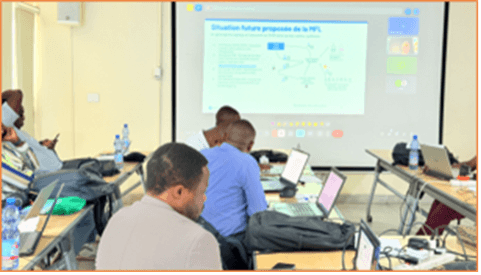
The process began with a kick-off meeting in Kinshasa that brought together ANICNS, Bluesquare, and Dev-Afrique to align on objectives, expected results, and governance arrangements. A detailed 12-week work plan was validated, with clear responsibilities and deliverables assigned to each partner.
From there, the team set about mapping the ecosystem. Eighteen key stakeholders were identified and classified according to their anticipated role in the future geo-registry, ranging from national health programmes such as PNLP, PRONANUT, and PNECHOL-MD, to technical partners including WHO, PATH, CHAI, VillageReach, and SANRU, and institutions holding critical geographic data such as DSNIS, IGC, and INS.
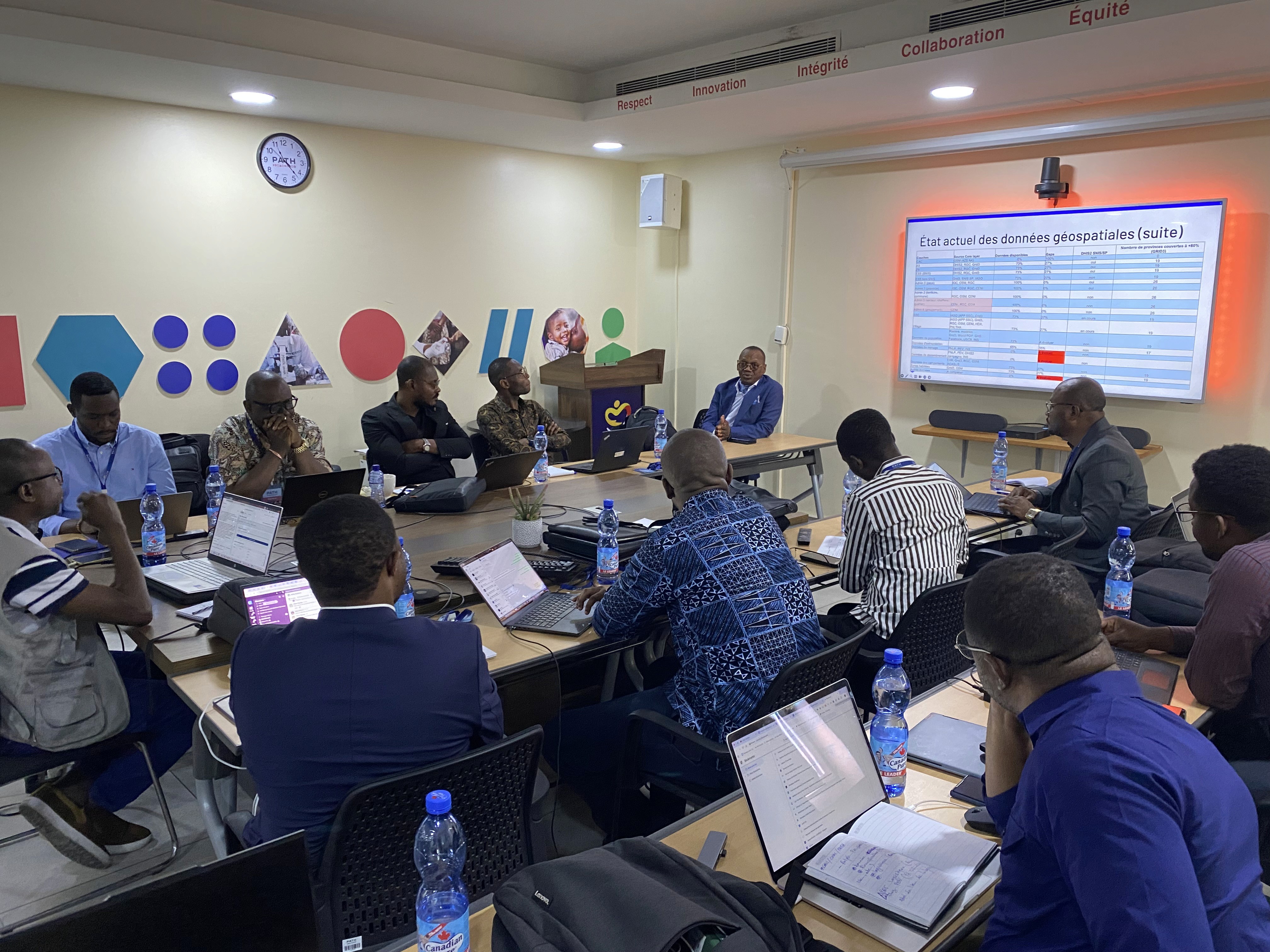
In September 2025, twenty actors from across the ecosystem gathered in Kinshasa for a three-day participatory diagnostic workshop. What emerged confirmed what many had long suspected. The DRC's geospatial ecosystem was rich but heavily fragmented and poorly harmonised. The workshop mapped more than 20 digital tools and platforms in active use for geospatial health data. Through a structured evaluation process that weighed criteria including interoperability, cost, accessibility, adoption, and sustainability, nine priority tools were identified and approved: DHIS2, QGIS, IASO, ODK/KoboToolbox, Gestion PEV, GTS Tracker, GRID3 Data Hub, and OpenStreetMap.
The workshop also produced a frank SWOT analysis of the landscape. On the strengths side, there was genuine political will, a clear institutional mandate for ANICNS, and a solid base of existing tools to build on. The weaknesses were equally real: fragmented databases, no harmonised standards, limited local geomatics expertise, and a heavy dependence on external financing. The opportunities ahead were considerable too, particularly growing demand for reliable data among decision-makers and donors, and the emerging potential of cloud computing and artificial intelligence for predictive analysis. Risks around cybersecurity, data sovereignty, institutional overlaps, and staff turnover were noted honestly, reinforcing why local ownership needed to be central to the design from the very beginning.
Between October and November 2025, the diagnostic findings fed into the development of an architectural framework, refined through iterative review with ANICNS. Structured around seven layers covering institutional governance, functional services, technical infrastructure, data, interoperability and integration, security, and sustainability, it served both as a synthesis of everything learned in the diagnostic phase and as an initial roadmap towards a national integrated geospatial platform.
A validation workshop in November 2025 brought the broader geodata community together to review the draft framework. Feedback was incorporated, and the final version was formally ratified and adopted.
This marked the first major milestone in deploying the national geo-registry. The next step will see ANICNS and Dev-Afrique work together to define the technical specifications and implementation calendar for 2026.
The process began with a kick-off meeting in Kinshasa that brought together ANICNS, Bluesquare, and Dev-Afrique to align on objectives, expected results, and governance arrangements. A detailed 12-week work plan was validated, with clear responsibilities and deliverables assigned to each partner.
From there, the team set about mapping the ecosystem. Eighteen key stakeholders were identified and classified according to their anticipated role in the future geo-registry, ranging from national health programmes such as PNLP, PRONANUT, and PNECHOL-MD, to technical partners including WHO, PATH, CHAI, VillageReach, and SANRU, and institutions holding critical geographic data such as DSNIS, IGC, and INS.
In September 2025, twenty actors from across the ecosystem gathered in Kinshasa for a three-day participatory diagnostic workshop. What emerged confirmed what many had long suspected. The DRC’s geospatial ecosystem was rich but heavily fragmented and poorly harmonised. The workshop mapped more than 20 digital tools and platforms in active use for geospatial health data. Through a structured evaluation process that weighed criteria including interoperability, cost, accessibility, adoption, and sustainability, nine priority tools were identified and approved: DHIS2, QGIS, IASO, ODK/KoboToolbox, Gestion PEV, GTS Tracker, GRID3 Data Hub, and OpenStreetMap.
The workshop also produced a frank SWOT analysis of the landscape. On the strengths side, there was genuine political will, a clear institutional mandate for ANICNS, and a solid base of existing tools to build on. The weaknesses were equally real: fragmented databases, no harmonised standards, limited local geomatics expertise, and a heavy dependence on external financing. The opportunities ahead were considerable too, particularly growing demand for reliable data among decision-makers and donors, and the emerging potential of cloud computing and artificial intelligence for predictive analysis. Risks around cybersecurity, data sovereignty, institutional overlaps, and staff turnover were noted honestly, reinforcing why local ownership needed to be central to the design from the very beginning.
Between October and November 2025, the diagnostic findings fed into the development of an architectural framework, refined through iterative review with ANICNS. Structured around seven layers covering institutional governance, functional services, technical infrastructure, data, interoperability and integration, security, and sustainability, it served both as a synthesis of everything learned in the diagnostic phase and as an initial roadmap towards a national integrated geospatial platform.
A validation workshop in November 2025 brought the broader geodata community together to review the draft framework. Feedback was incorporated, and the final version was formally ratified and adopted.
This marked the first major milestone in deploying the national geo-registry. The next step will see ANICNS and Dev-Afrique work together to define the technical specifications and implementation calendar for 2026.
How the Partnership Worked
It is worth saying something about how this project actually functioned, because the way partners worked together was as important as what each brought individually.
ANICNS held institutional leadership throughout, ensuring national ownership of the future registry and keeping the work aligned with the DRC's broader digital health priorities. Bluesquare led technical coordination, managed the work plan, and consolidated deliverables. Dev-Afrique provided quality assurance and oversight, ensuring alignment with stakeholder requirements and global standards, whilst also contributing directly to technical inputs that went well beyond typical fund administration.ANICNS provided institutional leadership, ensuring ownership of the future registry and alignment with national digital health priorities. Bluesquare led technical coordination, managed the work plan, and consolidated deliverables. Dev-Afrique exercised quality assurance and oversight, ensuring alignment with stakeholder-defined requirements and global standards, while also contributing directly to technical inputs that went beyond typical fund administration.
How the Partnership Worked
It is worth saying something about how this project actually functioned, because the way partners worked together was as important as what each brought individually.
ANICNS held institutional leadership throughout, ensuring national ownership of the future registry and keeping the work aligned with the DRC’s broader digital health priorities. Bluesquare led technical coordination, managed the work plan, and consolidated deliverables. Dev-Afrique provided quality assurance and oversight, ensuring alignment with stakeholder requirements and global standards, whilst also contributing directly to technical inputs that went well beyond typical fund administration.ANICNS provided institutional leadership, ensuring ownership of the future registry and alignment with national digital health priorities. Bluesquare led technical coordination, managed the work plan, and consolidated deliverables. Dev-Afrique exercised quality assurance and oversight, ensuring alignment with stakeholder-defined requirements and global standards, while also contributing directly to technical inputs that went beyond typical fund administration.

The division of roles was clear, the coordination mechanisms were consistent, and when disruptions arose the project absorbed them and kept moving. That kind of stability does not happen by accident. It is the product of partners who trust each other and take their commitments seriously.
A Strategic Milestone and Invitation to Collaborate
A national health geo-registry is not simply a technical project. It is an investment in the DRC's capacity to govern its health system through evidence, to respond to epidemics with speed and precision, to plan services around actual need, and to do all of this on its own terms, with its own data infrastructure, managed by its own institutions.
The foundation has been carefully laid. The momentum is real. And perhaps the most encouraging sign is the growing enthusiasm from across the ecosystem: national programmes, international partners, and technical actors who increasingly see the geo-registry not as something being built for them, but as something they genuinely want and intend to use.
That matters, because a national geo-registry only realises its potential when it is truly shared. Its value grows with every institution that contributes data, every system that connects to it, and every decision that is better for it. If you are working in health, data, or digital systems across the DRC or the wider region, we would welcome a conversation about how your work might connect with and strengthen this platform.
The door is open. We would love to hear from you.
The division of roles was clear, the coordination mechanisms were consistent, and when disruptions arose the project absorbed them and kept moving. That kind of stability does not happen by accident. It is the product of partners who trust each other and take their commitments seriously.
A Strategic Milestone and Invitation to Collaborate
A national health geo-registry is not simply a technical project. It is an investment in the DRC’s capacity to govern its health system through evidence, to respond to epidemics with speed and precision, to plan services around actual need, and to do all of this on its own terms, with its own data infrastructure, managed by its own institutions.
The foundation has been carefully laid. The momentum is real. And perhaps the most encouraging sign is the growing enthusiasm from across the ecosystem: national programmes, international partners, and technical actors who increasingly see the geo-registry not as something being built for them, but as something they genuinely want and intend to use.
That matters, because a national geo-registry only realises its potential when it is truly shared. Its value grows with every institution that contributes data, every system that connects to it, and every decision that is better for it. If you are working in health, data, or digital systems across the DRC or the wider region, we would welcome a conversation about how your work might connect with and strengthen this platform.
The door is open. We would love to hear from you.