Building Lasting Geospatial Capacity for Health Systems at National Scale
Product
8 min read

Published on
March 2026
Across many low- and middle-income countries, health programs are generating more data than ever before. Yet the ability to consistently analyze, interpret, and apply this data remains uneven. Capacity-building efforts are often fragmented, tied to short-term projects, and disconnected from national systems, resulting in high dependency on external partners and limited institutional ownership.
Introduction
The Umbrella Fund for Geospatial Interventions was designed to respond to this emerging need by shifting capacity development away from one-off training toward institutionalized, system-level solutions. A core pillar of this approach is curriculum development and institutionalization at the national level, implemented in close collaboration with national implementing organizations and partner training institutions.
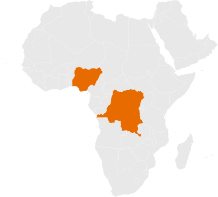
This intervention is currently being implemented in:
Nigeria: through Solina Health, in partnership with the National Space Research and Development Agency (NASRDA). National level training resources and curricula are hosted on the National Geospatial Learning Hub: https://nationalgeospatialhub.nasrda.gov.ng/
Democratic Republic of Congo (DRC): through the Kinshasa School of Public Health (KSPH), in partnership with the University of Kananga, University of Mbuji Mayi, and University of Lubumbashi. Digital delivery and course materials are hosted on KSPH’s Moodle learning platform: https://espkin.moodiy.com
The Challenge: Building Institutionalize Capacities Beyond Ad Hoc Trainings
Prior to this investment, geospatial and health data capacity-building efforts were largely characterized by:
Ad hoc trainings not embedded within formal education or government systems, leading to weak continuity and limited institutional ownership
Limited alignment between national priorities and subnational realities, resulting in curricula that did not reflect the operational context of health workers. This intervention is currently being implemented in:
In Nigeria, Solina Health, in partnership with NASRDA, led extensive stakeholder engagement with 19 national institutions, including NPHCDA, FMoH, NCDC, NBS, and others. This process was followed by a structured geospatial capacity needs assessment involving interviews across government agencies and development partners. The findings directly informed the scope, structure, and sequencing of the national curriculum.
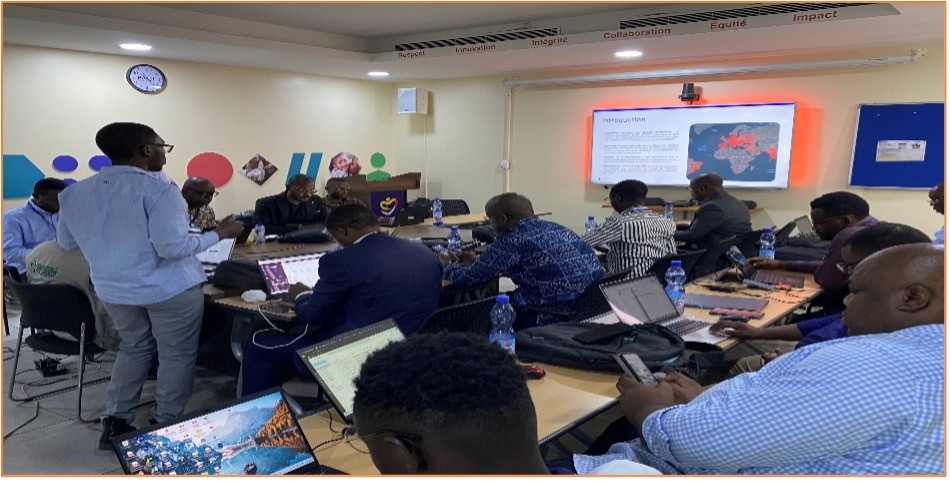
In the DRC, KSPH worked closely with the Ministry of Health, DSNIS, provincial health divisions (DPS), and key programs such as EPI and NMCP. Stakeholder mapping and interviews across five provinces ensured the curriculum reflected both national frameworks and provincial operational realities.
The Challenge: Building Institutionalize Capacities Beyond Ad Hoc Trainings
While curriculum leadership sits at the national level, implementation is deliberately linked to subnational actors and academic institutions (Read more about our subnational-level geospatial data capacity intervention). This ensures that training content is not only standardized, but also practical and usable in real program contexts. In Nigeria, this alignment has been reinforced through collaboration with state PHC agencies, universities, and implementing partners. In the DRC, provincial GIS focal points and health program leaders played a central role in validating curriculum content through workshops and consultations.
Progres to Date: From Design to Adoption
Progress under this investment is now visible through operational platforms, accredited learning pathways, and institutionally issued certificates in both Nigeria and the DRC.
Nigeria: Solina Health with NASRDA
In Nigeria, progress has moved decisively from curriculum design to national hosting, governance, and delivery:
The National Geospatial Learning Hub, hosted by NASRDA, is live and serves as the national repository for geospatial health curricula, training materials, and curated datasets: https://nationalgeospatialhub.nasrda.gov.ng/
A structured Geospatial Technology for Health Professionals learning pathway is offered across Introductory, Intermediate, and Advanced levels, supporting progressive skills development for health and data professionals.
Learners completing these pathways receive institutionally issued certificates anchored within NASRDA’s national training mandate, reinforcing legitimacy and long‑term continuity.
Training delivery is being implemented through hybrid models that combine digital access to learning resources with in‑person practical sessions, strengthening applied use within health programs.
Democratic Republic of Congo: Kinshasha School of Public Health (KSPH)
In the DRC, progress has focused on academic institutionalization and digitally enabled delivery led by KSPH:
KSPH developed the full suite of training materials and a dedicated Moodle-based learning platform, which serves as the digital repository for the validated geospatial health curriculum and all associated course content: https://espkin.moodiy.com
The platform supports structured online and blended learning and is complemented by the Moodle Mobile application on Android, enabling access for learners using mobile devices: https://play.google.com/store/apps/details?id=com.moodiy.moodlemobile
Through this platform, KSPH is delivering certificate based short courses in GIS and geospatial analysis for public health, aligned with national priorities and provincial operational needs.
Certification pathways are coordinated with provincial health divisions (DPS) and national programs, ensuring relevance to real world planning, surveillance, and service delivery contexts.
These milestones mark a clear transition from project based training toward academically anchored, nationally relevant certification pathways that can be sustained within the DRC’s public health education system.
Across both countries, the shift is evident: geospatial capacity development is now being delivered through formal platforms, recognized institutions, and certified learning pathways, laying the foundation for long-term adoption and scale.
Early Result: What is Changing
Although institutional change takes time, early results are already visible:
Health and data professionals are engaging with geospatial concepts through structured, context-relevant curricula
Universities and training institutions are advancing internal processes to transform curriculum modules into accredited offerings
National stakeholders report improved alignment between data capacity-building efforts and policy priorities
Subnational implementers are better positioned to interpret and apply spatial data for planning and monitoring
Looking Ahead: What Scaling Looks Like
Scaling this model is a systematic expansion, focused on enabling additional training institutions to adopt and replicate the curriculum, extending reach to millions of health workers, and ensuring that PHC agencies, organizations, and individuals recognize these pathways as credible, professional routes for geospatial training.
The next phase will focus on:
Formal approval and accreditation of curricula within national and university governance structures
Expanding delivery across additional training institutions and provinces
Strengthening linkages between curriculum delivery and national health data systems
Mobilizing domestic resources and co‑financing to sustain training programs
By anchoring geospatial capacity development within nationally recognized institutions, while remaining responsive to subnational needs, the Umbrella Fund is laying the groundwork for a replicable model that other countries can adapt.