8 min read

Strengthening Geospatial and Health Data Capacity at the Subnational Level in Nigeria: Lessons from Anambra State
Strengthening Geospatial and Health Data Capacity at the Subnational Level in Nigeria: Lessons from Anambra State

Published on

April 2026

Published on

April 2026

Introduction

Geospatial data and technologies play a critical role in strengthening the last-mile delivery of health interventions. Yet in Nigeria, adoption within the primary healthcare (PHC) system, at both national and subnational levels, has remained limited. To understand the gap between potential and practice, the Umbrella Fund anchored its work on two prior diagnostics: a national geospatial value pipeline assessment and a subnational geospatial capacity assessment conducted by Dev-Afrique and commissioned by the Gates Foundation’s Geospatial Insights Support Team (GIST).


Introduction

Geospatial data and technologies play a critical role in strengthening the last-mile delivery of health interventions. Yet in Nigeria, adoption within the primary healthcare (PHC) system, at both national and subnational levels, has remained limited. To understand the gap between potential and practice, the Umbrella Fund anchored its work on two prior diagnostics: a national geospatial value pipeline assessment and a subnational geospatial capacity assessment conducted by Dev-Afrique and commissioned by the Gates Foundation’s Geospatial Insights Support Team (GIST).

These assessments uncovered several challenges across the geospatial value pipeline, including limited geospatial capacity among PHC officials, the absence of functioning geospatial data systems, and poor management and utilisation of spatial data for health program planning and implementation.

Building on these findings, the Umbrella Fund conducted additional validation and stakeholder consultations to ground the evidence in operational realities and translate it into an implementable intervention. This process directly informed the design of the subnational geospatial data and health system intervention focused on strengthening the capacity of the health data team to access, integrate, and analyze geospatial and routine health data. The approach emphasizes the establishment of localised data systems and institutionalization of geospatial data training in the state structure, intending to promote local ownership and routine use of geo-analysis for campaign planning, monitoring, tracking, and reporting.

To date, the Umbrella Fund has deployed this intervention in three Nigerian states, including Anambra, Niger, and Kebbi, each at different stages of implementation. Activities in Anambra State are concluding, while Niger and Kebbi are at the initiation and planning phase. This article spotlights the Anambra experience, highlighting what was implemented, what was achieved, and the key lessons that emerged from translating geospatial strategy into subnational practice.


Implementation in Anambra

Following consultations and alignment with the Anambra State Primary Healthcare Agency (ASPHCDA), Octave Analytics was engaged as the implementing partner to drive the intervention in Anambra State. The intervention officially commenced on 11 August 2025 and was designed as a six-month project. Octave worked closely with the ASPHCDA and the Anambra State Ministry of Health (ASMoH) to strengthen geospatial and health data capacity for health programs by deploying a centralised data hub and institutionalising geospatial training to improve data management and analysis at state and local levels.

Implementation began with structured engagements with ASPHCDA, ASMOH, and other critical stakeholders, along with a situational assessment to identify gaps in geospatial capacity and to co-develop context-appropriate strategies to strengthen data systems. These consultations ensured that the intervention was grounded in Anambra’s operational realities and helped secure buy-in from state-level decision-makers, laying the foundation for effective implementation and uptake.

Designing and Deploying the Anambra Geohub

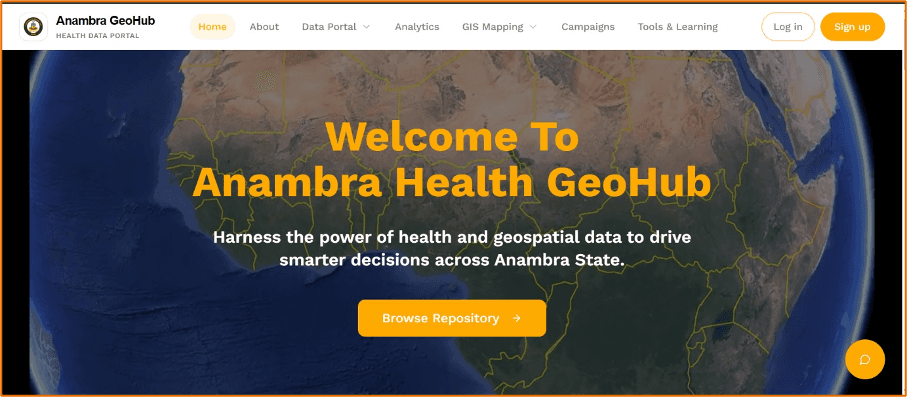
Octave designed the Anambra GeoHub, a centralised geospatial health data repository anchored in an architectural framework informed by the consultations and the situational assessment findings. Development followed a participatory approach, with PHC data staff actively involved in both the design and testing phases to ensure relevance and usability.

The GeoHub consolidates geospatial and routine health datasets across key programmes, including Malaria, Routine Immunisation, Polio, HIV/AIDS, and Tuberculosis. Core functionalities include an interactive dashboard to support campaign planning and monitoring, role-based access controls, and downloadable datasets that enable independent analysis by state and LGA officials.

Prior to deployment, the GeoHub underwent review and validation workshops with PHC and LGA-level stakeholders to demonstrate functionalities and incorporate feedback. Senior leadership engagement, including the ES of the ASPHCDA and the Director of Community Health Services, was sustained throughout implementation. The platform has now been fully migrated to the Anambra State government domain server, enabling full state ownership and direct management of hosting and access.

Access the Anambra GeoHub platform by clicking on this link: Anambra GeoHub

Logo

An initiative By

Devafrique

Our Footprint

Footprint Map

Learn More About the Fund

Terms of Service

Privacy Policy/GDPR

Cookies

Licenses

Contact Us

team@umbrellafund.org

© 2025 The Umbrella Fund. All rights reserved

Terms of Service

Privacy Policy/GDPR

Cookies

These assessments uncovered several challenges across the geospatial value pipeline, including limited geospatial capacity among PHC officials, the absence of functioning geospatial data systems, and poor management and utilisation of spatial data for health program planning and implementation.

Building on these findings, the Umbrella Fund conducted additional validation and stakeholder consultations to ground the evidence in operational realities and translate it into an implementable intervention. This process directly informed the design of the subnational geospatial data and health system intervention focused on strengthening the capacity of the health data team to access, integrate, and analyze geospatial and routine health data. The approach emphasizes the establishment of localised data systems and institutionalization of geospatial data training in the state structure, intending to promote local ownership and routine use of geo-analysis for campaign planning, monitoring, tracking, and reporting.

To date, the Umbrella Fund has deployed this intervention in three Nigerian states, including Anambra, Niger, and Kebbi, each at different stages of implementation. Activities in Anambra State are concluding, while Niger and Kebbi are at the initiation and planning phase. This article spotlights the Anambra experience, highlighting what was implemented, what was achieved, and the key lessons that emerged from translating geospatial strategy into subnational practice.

Implementation in Anambra

Following consultations and alignment with the Anambra State Primary Healthcare Agency (ASPHCDA), Octave Analytics was engaged as the implementing partner to drive the intervention in Anambra State. The intervention officially commenced on 11 August 2025 and was designed as a six-month project. Octave worked closely with the ASPHCDA and the Anambra State Ministry of Health (ASMoH) to strengthen geospatial and health data capacity for health programs by deploying a centralised data hub and institutionalising geospatial training to improve data management and analysis at state and local levels.

Implementation began with structured engagements with ASPHCDA, ASMOH, and other critical stakeholders, along with a situational assessment to identify gaps in geospatial capacity and to co-develop context-appropriate strategies to strengthen data systems. These consultations ensured that the intervention was grounded in Anambra’s operational realities and helped secure buy-in from state-level decision-makers, laying the foundation for effective implementation and uptake.


Designing and Deploying the Anambra Geohub

Octave designed the Anambra GeoHub, a centralised geospatial health data repository anchored in an architectural framework informed by the consultations and the situational assessment findings. Development followed a participatory approach, with PHC data staff actively involved in both the design and testing phases to ensure relevance and usability.

The GeoHub consolidates geospatial and routine health datasets across key programmes, including Malaria, Routine Immunisation, Polio, HIV/AIDS, and Tuberculosis. Core functionalities include an interactive dashboard to support campaign planning and monitoring, role-based access controls, and downloadable datasets that enable independent analysis by state and LGA officials.

Prior to deployment, the GeoHub underwent review and validation workshops with PHC and LGA-level stakeholders to demonstrate functionalities and incorporate feedback. Senior leadership engagement, including the ES of the ASPHCDA and the Director of Community Health Services, was sustained throughout implementation. The platform has now been fully migrated to the Anambra State government domain server, enabling full state ownership and direct management of hosting and access.

Access the Anambra GeoHub platform by clicking on this link: Anambra GeoHub

Building Capacity for Sustained Use

To ensure sustained and effective use of the GeoHub, Octave implemented a structured capacity-building approach starting with a training of trainers exercise with 30 selected ASPHCDA staff. These trainers subsequently cascaded the training to more than 210 health data staff across the state, LGA, and PHC levels.

In parallel,  Octave adapted the national geospatial curriculum to the Anambra context and embedded it within the Anambra State College of Health Technology (ASCOHT), the institution through which 85% of Anambra's PHC workers graduate, to institutionalize and facilitate geospatial training for health workers in Anambra state. This institutionalization creates a sustainable pipeline for building and maintaining geospatial capacity among current and future health workers in the state.

Outcome and Impact

As the initiative nears completion, it has delivered a tangible shift in Anambra's geospatial and health data landscape. A centralised geospatial health data repository is now operational, consolidating datasets that were previously fragmented across disease programmes and units.

The national geospatial curriculum has been localised and embedded within ASCOHT, creating an institutional pathway for continuous workforce development. Together, these investments move geospatial analysis from a project‑based activity to a routine, system‑embedded function. The GeoHub’s deployment on the state government domain further signals a concrete shift towards state-led ownership and governance of geospatial health data infrastructure.

Implementation and Challenges

Two key challenges emerged during implementation. First was resistance to data sharing, driven largely by uncertainty among stakeholders about the purpose and governance of the GeoHub. This constrained access to health datasets in the initial phase and required sustained engagement to build trust and clarify value

Second, sustainability requirements became more visible as implementation progressed. Both the Anambra State government and ASCOHT indicated the need for financial resources to assume responsibilities being transferred to them, including platform hosting, maintenance, and curriculum delivery. These recurrent costs were not fully scoped at the concept stage and were identified late in the implementation cycle, limiting the time available to plan for long‑term financing.


Lessons Learned

The Anambra experience underscores the importance of early and continuous institutional engagement. Persistent stakeholder dialogue proved essential in overcoming initial data access barriers and strengthening confidence in shared geospatial systems.

Equally critical is the need to treat sustainability as a first‑order design consideration. Costing questions, such as what it will take for a state to host and maintain a data platform or for a training institution to independently deliver a curriculum, must be addressed up front. Answering these questions at the concept stage enables clearer transition planning, reduces implementation risk, and strengthens the case for government ownership from the outset.

Building Capacity for Sustained Use

To ensure sustained and effective use of the GeoHub, Octave implemented a structured capacity-building approach starting with a training of trainers exercise with 30 selected ASPHCDA staff. These trainers subsequently cascaded the training to more than 210 health data staff across the state, LGA, and PHC levels.

In parallel,  Octave adapted the national geospatial curriculum to the Anambra context and embedded it within the Anambra State College of Health Technology (ASCOHT), the institution through which 85% of Anambra's PHC workers graduate, to institutionalize and facilitate geospatial training for health workers in Anambra state. This institutionalization creates a sustainable pipeline for building and maintaining geospatial capacity among current and future health workers in the state.

Outcome and Impact

As the initiative nears completion, it has delivered a tangible shift in Anambra's geospatial and health data landscape. A centralised geospatial health data repository is now operational, consolidating datasets that were previously fragmented across disease programmes and units.

The national geospatial curriculum has been localised and embedded within ASCOHT, creating an institutional pathway for continuous workforce development. Together, these investments move geospatial analysis from a project‑based activity to a routine, system‑embedded function. The GeoHub’s deployment on the state government domain further signals a concrete shift towards state-led ownership and governance of geospatial health data infrastructure.

Implementation and Challenges

Two key challenges emerged during implementation. First was resistance to data sharing, driven largely by uncertainty among stakeholders about the purpose and governance of the GeoHub. This constrained access to health datasets in the initial phase and required sustained engagement to build trust and clarify value

Second, sustainability requirements became more visible as implementation progressed. Both the Anambra State government and ASCOHT indicated the need for financial resources to assume responsibilities being transferred to them, including platform hosting, maintenance, and curriculum delivery. These recurrent costs were not fully scoped at the concept stage and were identified late in the implementation cycle, limiting the time available to plan for long‑term financing.


Lessons Learned

The Anambra experience underscores the importance of early and continuous institutional engagement. Persistent stakeholder dialogue proved essential in overcoming initial data access barriers and strengthening confidence in shared geospatial systems.

Equally critical is the need to treat sustainability as a first‑order design consideration. Costing questions, such as what it will take for a state to host and maintain a data platform or for a training institution to independently deliver a curriculum, must be addressed up front. Answering these questions at the concept stage enables clearer transition planning, reduces implementation risk, and strengthens the case for government ownership from the outset.